|
 Instantly
Updated information from LHC
http://twitter.com/cern/
Latest
news from the CMS Experiment
https://cms.web.cern.ch/cms/index.html
IPM
meeting appears in CMS Times
http://cms.web.cern.ch/cms/Media/Publications/CMStimes/2009/05_18/index.html
SCOAP3 Open Access Initiative
launched at CERN
Geneva 1
October 2012.
Representatives from the science funding agencies and library
communities of 29 countries are meeting at CERN today to
launch the SCOAP3 Open Access initiative. Open Access
revolutionizes the traditional scientific publishing model with
scientific papers being made freely available to all, and
publishers paid directly for their indispensable peer-review
services to the community.
more
European particle physics refreshes long-term strategy
Krakow, 12
September 2012.
Some 500 particle physicists meeting in Krakow this week have
been debating the long-term future of their field at the CERN
Council Open Symposium on the European Strategy for Particle
Physics. This symposium comes at a turning point for the field,
following hot on the heels of the announcement in July by CERN
experiments ATLAS and CMS of the discovery of a new particle
consistent with the long-sought Higgs boson: a discovery that
sets the direction for future particle physics research.
Although the LHC results have dominated the headlines, other
areas, such as neutrino physics, have also seen important
advances over recent years.more
LHC
experiments bring new insight into matter of the primordial
Universe
Geneva, 13
August 2012.
Experiments using heavy ions at CERN’s Large Hadron Collider
(LHC) are advancing understanding of the primordial
Universe. The ALICE, ATLAS and CMS collaborations have made
new measurements of the kind of matter that probably existed
in the first instants of the Universe. They will present
their latest results at the 2012 Quark Matter conference,
which starts today in
Washington DC. The new findings are based mainly on the
four-week LHC run with lead ions in 2011, during which the
experiments collected 20 times more data than in 2010.
more

Lecture
by Professor Peter Higgs at Swansea University 'My
life as a boson'
more
http://www.swan.ac.uk/media-centre/livestreaming/higgs-boson/
LIVE STREAM: Thursday 12th July,4-5pm
European
science champions score an early goal for cloud computing
Geneva, 9 July 2012."Helix
Nebula – the science cloud", set up earlier
this year to
support the massive IT requirements of European scientists
and create a cloud-computing market for the public sector in
Europe, has today announced the initial deployment of its
first flagship applications in high-energy physics,
molecular biology and natural-disaster risk management.
more
Time: Monday, July 9, 2012
CERN experiments observe particle consistent
with long-sought Higgs boson
Geneva, 4 July 2012.
At a seminar held at CERN1 today
as a curtain raiser to the year’s major particle physics
conference, ICHEP2012 in Melbourne, the ATLAS and CMS
experiments presented their latest preliminary results in
the search for the long sought Higgs particle. Both
experiments observe a new particle in the mass region around
125-126 GeV.
Statement from CERN
/
in persian
Statement from
CMS
/
in
persian
Statement from IPM
Photo Gallery
Time: Wednesday, July 4, 2012
CERN to give update on Higgs search as
curtain raiser to ICHEP conference
Geneva, 22 June 2012. CERN1 will
hold a scientific seminar at 9:00CEST on 4 July to deliver the
latest update in the search for the Higgs boson. At this
seminar, coming on the eve of this year’s major particle physics
conference, ICHEP, in Melbourne, the ATLAS and CMS experiments
will deliver the preliminary results of their 2012 data
analysis.
“Data taking for
ICHEP concluded on Monday 18 June after a very successful first
period of LHC running in 2012,” said
CERN’s Director for Accelerators and Technology, Steve Myers. “I’m
very much looking forward to seeing what the data reveals.” more
Time: June 22, 2012
New phase of CERN openlab to tackle exascale
IT challenges for science
The fourth phase of CERN openlab was
officially launched during a meeting of its board of
sponsors taking place at CERN on 8 and 9 May. CERN openlab
is a unique public-private partnership between CERN and
leading information technology companies HP, Intel, Oracle,
Siemens, with contribution from Huawei for this new phase.
Its mission is to accelerate the development of cutting-edge
solutions to be used by the worldwide community working on
LHC data. more
Time: May 9, 2012
LHC physics data taking
gets underway at new record collision energy of 8TeV
(April 5, 2012)
At 0:38 CEST this morning, the
LHC shift crew declared ‘stable beams’ as two 4 TeV proton beams
were brought into collision at the LHC’s four interaction
points. This signals the start of physics data taking by the LHC
experiments for 2012. The collision energy of 8 TeV is a new
world record, and increases the machine’s discovery potential
considerably.
Full Story
CERN experiment makes spectroscopic
measurement of antihydrogen
(March
7, 2012)
In a
paper published online today by
the journal Nature, the ALPHA collaboration at CERN reports an
important milestone on the way to measuring the properties of
antimatter atoms. This follows news reported in June last year
that the collaboration had routinely trapped antihydrogen atoms
for long periods of time. ALPHA’s latest advance is the next
important milestone on the way to being able to make precision
comparisons between atoms of ordinary matter and atoms of
antimatter, thereby helping to unravel one of the deepest
mysteries in particle physics and perhaps understanding why a
Universe of matter exists at all.
Full Story
LHCb
experiment squeezes the space for expected new physics
(March
5, 2012)
Results presented by the LHCb
collaboration this evening at the annual ‘Rencontres de Moriond’
conference, held this year in La Thuile, Italy, have put one of
the most stringent limits to date on the current theory of
particle physics, the Standard Model. LHCb tests the Standard
Model by measuring extremely rare processes, in this case a
decay pattern predicted to happen just three times out of every
billion decays of a particle known as the Bs (B-sub-s) meson.
Anything other than that would be evidence for new physics.
Measuring the rate of this Bs decay has been a major goal of
particle physics experiments in the past decade, with the limit
on its decay rate being gradually improved by the CDF and D0
experiments at Fermilab, LHCb, and most recently CMS at CERN1.
Full Story
Update on the OPERA Result
(February
22, 2012)
The OPERA
collaboration has informed its funding agencies and host
laboratories that it has identified two possible effects that
could have an influence on its neutrino timing measurement.
These both require further tests with a short pulsed beam. If
confirmed, one would increase the size of the measured effect,
the other would diminish it. The first possible effect concerns
an oscillator used to provide the time stamps for GPS
synchronizations. It could have led to an overestimate of the
neutrino's time of flight. The second concerns the optical fibre
connector that brings the external GPS signal to the OPERA
master clock, which may not have been functioning correctly when
the measurements were taken. If this is the case, it could have
led to an underestimate of the time of flight of the neutrinos.
The potential extent of these two effects is being studied by
the OPERA collaboration. New measurements with short pulsed
beams are scheduled for May.
LHC to run at 4 TeV per beam in 2012
(February
13, 2012)
CERN today announced
that the LHC will run with a beam energy of 4 TeV this year, 0.5
TeV higher than in 2010 and 2011. This decision was taken by
CERN management following the annual performance workshop held
in Chamonix last week and a report delivered todayby
the external CERN Machine Advisory Committee (CMAC). It is
accompanied by a strategy to optimise LHC running to deliver the
maximum possible amount of data in 2012 before the LHC goes into
a long shutdown to prepare for higher energy running. The data
target for 2012 is 15 inverse femtobarns for ATLAS and CMS,
three times higher than in 2011. Bunch spacing in the LHC will
remain at 50 nanoseconds.
Full Story
ATLAS and CMS experiments present Higgs search
status
(December
13, 2011)
In a seminar held at CERN today,
the ATLAS and CMS experiments presented the status
of their searches for the Standard Model Higgs boson. Their
results are based on the analysis of considerably more data than
those presented at the summer conferences, sufficient to make
significant progress in the search for the Higgs boson, but not
enough to make any conclusive statement on the existence or
non-existence of the elusive Higgs. The main conclusion is that
the Standard Model Higgs boson, if it exists, is most likely to
have a mass constrained to the range 116-130 GeV by the ATLAS
experiment, and 115-127 GeV by CMS. Tantalising hints
have been seen by both experiments in this mass region, but
these are not yet strong enough to claim a discovery.
Full Story
in English
Full Story in Persian
CMS/ATLAS combination on the SM Higgs Searches
(November 18, 2011)
OPERA experiment update
(November 18, 2011)
Following the
OPERA collaboration's presentation at CERN on 23 September,
inviting scrutiny of their neutrino time-of-flight measurement
from the broader particle physics community, the collaboration
has rechecked many aspects of its analysis and taken into
account valuable suggestions from a wide range of sources. One
key test was to repeat the measurement with very short beam
pulses from CERN. This allowed the extraction time of the
protons that ultimately lead to the neutrino beam to be measured
more precisely.
The beam sent
from CERN consisted of pulses three nanoseconds long separated
by up to 524 nanoseconds. Some 20 clean neutrino events were
measured at the Gran Sasso Laboratory, and precisely associated
with the pulse leaving CERN. This test confirms the accuracy of
OPERA's timing measurement, ruling out one potential source of
systematic error. The new measurements do not change the initial
conclusion. Nevertheless, the observed anomaly in the neutrinos'
time of flight from CERN to Gran Sasso still needs further
scrutiny and independent measurement before it can be refuted or
confirmed.
On 17 November, the collaboration submitted
a paper on this measurement to the peer reviewed journal JHEP.
This paper is also available on the ArXiv
preprint server.
CERN has 2020 vision for LHC upgrade
(November
16, 2011)
CERN1 today
kicked off the High Luminosity LHC study with a workshop bringing
together scientists and engineers from some 14 European
institutions, supported through the European Commission’s
seventh Framework programme (FP7), along with others from Japan
and the USA. The goal is to prepare the ground for an LHC
luminosity upgrade scheduled for around 2020. Luminosity gives a
measure of the collision rate in a particle accelerator and
therefore gives an indication of its performance. Full
Story
LHC proton run for 2011 reaches successful
conclusion
(October
31, 2011)
After some 180 days of running and four hundred
trillion proton proton collisions, the LHC’s 2011 proton run
came to an end at 5.15pm yesterday evening. For the second year
running, the LHC team has largely surpassed its operational
objectives, steadily increasing the rate at which the LHC has
delivered data to the experiments.
Full Story
OPERA
experiment reports anomaly in flight time of neutrinos from CERN
to Gran Sasso
(September 23, 2011)
The OPERA1 experiment,
which observes a neutrino beam from CERN2 730
km away at Italy’s INFN Gran Sasso Laboratory, will present new
results in a seminar at CERN this afternoon at 16:00 CEST. The
seminar will be webcast at http://webcast.cern.ch.
Journalists wishing to ask questions may do so via twitter using
the hash tag #nuquestions, or via the usual CERN press office
channels.
Full Story
CERN's LHCb experiment takes precision physics to
a new level
(August 26, 2011)
Results to be presented by CERN1’s
LHCb experiment at the biennial Lepton-Photon conference in
Mumbai, India on Saturday 27 August are becoming the most
precise yet on particles called B mesons, which provide a way to
investigate matter-antimatter asymmetry. The LHCb experiment
studies this phenomenon by observing the way B mesons decay into
other particles. The new results reinforce earlier measurements
from LHCb presented at last month’s European Physical Society
conference in Grenoble, France, showing that the B meson decays
so far measured by the collaboration are in full agreement with
predictions from the Standard Model of particle physics, the
theory physicists use to describe the behaviour of fundamental
particles.
Full Story
CERN’s
CLOUD experiment provides unprecedented insight into cloud
formation
(August 25, 2011)
In a paper published in the journal Nature today,
the CLOUD1 experiment
at CERN2 has
reported its first results. The CLOUD experiment has been
designed to study the effect of cosmic rays on the formation of
atmospheric aerosols - tiny liquid or solid particles suspended
in the atmosphere - under controlled laboratory conditions.
Atmospheric aerosols are thought to be responsible for a large
fraction of the seeds that form cloud droplets. Understanding
the process of aerosol formation is therefore important for
understanding the climate.
Full Story
LHC
experiments present latest results at Mumbai conference
(August 22, 2011)
Results from the ATLAS and CMS collaborations,
presented at the biennial Lepton-Photon conference in Mumbai,
India today, show that the elusive Higgs particle, if it exists,
is running out of places to hide. Proving or disproving the
existence the Higgs boson, which was postulated in the 1960s as
part of a mechanism that would confer mass on fundamental
particles, is among the main goals of the LHC scientific
programme. ATLAS and CMS have excluded the existence of a Higgs
over most of the mass region 145 to 466 GeV with 95 percent
certainty.
Full Story
CERN
supports European Year of Volunteering through Citizen
Cyberscience Centre
(August 8, 2011)
Researchers at CERN began
public testing of a new version of the popular volunteer
computing project LHC@home[1] .
This version allows volunteers to participate for the first time
in simulating high-energy collisions of protons in CERN’s Large
Hadron Collider (LHC). Thus, volunteers can now actively help
physicists in the search for new fundamental particles that will
provide insights into the origin of our Universe, by
contributing spare computing power from their personal computers
and laptops. This is just one example of a series of projects
and events organized by the Citizen Cyberscience Centre[2],
a partnership between CERN, UNITAR (the UN Institute for
Training and Research) and the University of Geneva, to promote
volunteer-based science in this, the European Year of
Volunteering 2011[3].
Full Story
CERN
experiment weighs antimatter with unprecedented accuracy
(July 28, 2011)
Geneva, 28 July 2011. In a paper
published today in the journal Nature, the Japanese-European
ASACUSA experiment at CERN1 reported
a new measurement of the antiproton’s mass accurate to about one
part in a billion. Precision measurements of the antiproton mass
provide an important way to investigate nature’s apparent
preference for matter over antimatter.
“This is a very satisfying result,”
said Masaki Hori, a project leader in the ASACUSA collaboration.
“It means that our measurement of the antiproton’s mass relative
to the electron is now almost as accurate as that of the
proton.”
Ordinary protons constitute about
half of the world around us, ourselves included. With so many
protons around it would be natural to assume that the proton
mass should be measurable to greater accuracy than that of
antiprotons. After today’s result, this remains true but only
just. In future experiments, ASACUSA expects to improve the
accuracy of the antiproton mass measurement to far better than
that for the proton. Any difference between the mass of protons
and antiprotons would be a signal for new physics, indicating
that the laws of nature could be different for matter and
antimatter.
To make these measurements
antiprotons are first trapped inside helium atoms, where they
can be ‘tickled’ with a laser beam. The laser frequency is then
tuned until it causes the antiprotons to make a quantum jump
within the atoms, and from this frequency the antiproton mass
can be calculated. However, an important source of
imprecision comes from the fact that the atoms jiggle around, so
that those moving towards and away from the beam experience
slightly different frequencies. A similar effect is what
causes the siren of an approaching ambulance to apparently
change pitch as it passes you in the street. In their previous
measurement in 2006, the ASACUSA team used just one laser beam,
and the achievable accuracy was dominated by this effect. This
time they used two beams moving in opposite directions, with the
result that the jiggle for the two beams partly cancelled out,
resulting in a four times better accuracy.
“Imagine measuring the weight of
the Eiffel tower” said Hori. “The accuracy we’ve achieved here
is roughly equivalent to making that measurement to within less
than the weight of a sparrow perched on top. Next time it will
be a feather.”
New CMS Results for the EPS 2011 Conference
The CMS collaboration is presenting its
latest results this week at the 2011 Europhysics Conference on
High-Energy Physics, held in Grenoble, France. These results are
based on about 1 inverse femtobarn of
data (100 trillion proton-proton collisions) from LHC running at
an energy of 7 TeV, which were collected in 2010 and 2011. They
include a wide range of searches for new physics and precise
measurements of Standard Model processes.
http://cms.web.cern.ch/cms/News/2011/EPS_2011/index.html
LHC experiments present their latest results at Europhysics
Conference on High Energy Physics
(July
21, 2011)
Geneva, 21 July 2011. The first of the major summer conferences
for particle physics opens today in Grenoble. All of the LHC
experiments will be presenting results, and a press conference
is scheduled for Monday 25 July. The conference follows an
extremely successful start to LHC running in 2011, and results
are eagerly awaited.
“So far we’ve collected as much data as was planned for the
whole of 2011 and that’s already a great achievement for the
LHC,” said CERN
Director General Rolf Heuer. “While
it’s still too early for the biggest discoveries, the
experiments are already accumulating interesting results.”
Full Story
CERN Council looks forward to summer conferences and new members (June
24, 2011)
Geneva, 24
June 2011. At its 159th session
this week, the CERN Council congratulated CERN on the excellent
performance of the LHC, and welcomed the news that formal
confirmation has been received from the five countries applying
for CERN Membership.
Full Story
LHC
achieves 2011 data milestone - Le LHC atteint son objectif pour
2011 (June
17, 2011)
Geneva, 17
June 2011. Today at
around 10:50 CEST, the amount of data accumulated by LHC
experiments ATLAS and CMS clicked over from 0.999 to 1 inverse
femtobarn, signalling an important milestone in the experiments’
quest for new physics. The number signifies a quantity
physicists call integrated luminosity, which is a measure of the
total number of collisions produced. One inverse femtobarn
equates to around 70 million million1 collisions,
and in 2010 it was the target set for the 2011 run. That it has
been achieved just three months after the first beams of 2011 is
testimony to how well the LHC is running.
Full Story
CERN experiment traps antimatter atoms for 1000 seconds(June
5, 2011)
In a paper published online by the journal Nature Physics today,
the ALPHA experiment at CERN reports that it has succeeded
in trapping antimatter atoms for over 16 minutes: long
enough to begin to study their properties in detail.
Full Story
LHC Experiments Present New Results at
Quark Matter 2011 Conference(May
23, 2011)
The three LHC experiments that study lead ion collisions all
presented their latest results today at
the annual Quark Matter conference, held this year in Annecy,
France. The results are based on analysis of data collected
during the last two weeks of the 2010 LHC run, when the LHC
switched from protons to lead-ions. All experiments report
highly subtle measurements, bringing heavy-ion physics into a
new era of high precision studies.
Full Story
Records, results and rumors
(April 28, 2011)
The
LHC has been colliding stable beams for over eight hours, and
the instantaneous luminosity is still higher than the record
starting luminosity we announced under a week ago. It’s a sign
of how well this magnificent machine is running that last week’s
milestone achievement already seems like ancient history. In a
week that’s also seen a lot of media interest in a leaked ATLAS
note, it’s important for us to stay focused on what really
matters for particle physics: delivering plenty of good quality
data to the experiments so they can produce reliable
peer-reviewed results.
Full Story
The AMS detector heads for the International Space Station
(April 27, 2011)
The AMS particle detector will take off on 29 April 2011 at
21.47 CEST onboard the very last mission of the space Shuttle
Endeavour. AMS, the Alpha Magnetic Spectrometer, will then be
installed on the International Space Station from where it will
explore the Universe for a period of over 10 years. AMS will
address some of the most exciting mysteries of modern physics,
looking for antimatter and dark matter in space, phenomena that
have remained elusive up to now.
Full Story
"6
December 2010"
CERN experiment makes progress towards
antihydrogen beams
Geneva, 6
December 2010. The ASACUSA[1] experiment
at CERN has taken an important step forward in developing an
innovative technique for studying antimatter. Using a novel
particle trap, called a CUSP trap, the experiment has
succeeded in producing significant numbers of antihydrogen
atoms in flight. This result is published today in
the journal Physical Review Letters.
Antimatter – or the lack of it – remains one of the biggest
mysteries of science. Matter and its counterpart are
identical except for opposite charge, and they annihilate
when they meet. At the Big Bang, matter and antimatter
should have been produced in equal amounts. However, we know
that our world is made up of matter: antimatter seems to
have disappeared. To find out what has happened to it,
scientists employ a range of methods to investigate whether
a tiny difference in the properties of matter and antimatter
could point towards an explanation.
One of these methods is to take one of
the best-known systems in physics, the hydrogen atom, which
is made of one proton and one electron, and check whether
its antimatter counterpart, antihydrogen, consisting of an
antiproton and a positron, behaves in the same way. The
challenge is to create antihydrogen atoms, and keep them
away from ordinary matter for long enough to study them.
ASACUSA’s CUSP trap uses a combination of magnetic fields to
bring antiprotons and positrons together to form
antihydrogen atoms, and then channel them along a vacuum
pipe where they can be studied in flight. So far, only a few
antihydrogen atoms have been produced in this way, but the
experiment’s ultimate goal is to produce enough to
investigate their behaviour in detail with the help of
microwaves.
ASACUSA’s approach is complementary to
that of the ALPHA experiment, which reported new results in
the journal Nature on 17 November. The
procedures used to form antihydrogen build on techniques
developed by a third antihydrogen experiment at CERN, ATRAP,
which pioneered trapping techniques in the 1990s, and is
also working on trapping antihydrogen.
“With these alternative methods of
producing and eventually studying antihydrogen, antimatter
will not be able to hide its properties from us much
longer,” said
Yasunori Yamazaki of Japan’s RIKEN research centre and a
team leader of the ASACUSA collaboration. “There’s
still some way to go, but we’re very happy to see how well
this technique works.”
CERN is the only laboratory in the world
that operates a dedicated low-energy antiproton facility. As
far back as 1995, the first nine atoms of antihydrogen were
produced at CERN. Then, in 2002, the ATHENA and ATRAP
experiments showed that it was possible to produce
antihydrogen in large quantities, opening up the possibility
of conducting detailed studies. Today,
CERN’s antihydrogen experiments are well on the way to
investigating this rarest of atoms.
-------------------
[1] ASACUSA
is an experiment at CERN’s Antiproton Decelerator (AD)
facility studying the properties of antimatter. The main
thrust of ASACUSA’s research programme to date has been the
creation and study of exotic atoms known as antiprotonic
helium. Normal helium has two electrons orbiting its
nucleus. In an antiprotonic helium atom, one electron has
been replaced by an antiproton. Study of such atoms has
enabled ASACUSA to measure the mass of antiprotons to very
high precision. In total, five experiments use the AD’s low
energy antiproton beams. ALPHA and ATRAP focus on studying
antihydrogen atoms. AEgIS, an experiment under construction,
will study the influence of gravity on antimatter, while ACE
is an experiment investigating the effectiveness of
antiprotons as a potential treatment for certain forms of
cancer.
" 26
November 2010"
LHC
experiments bring new insight into primordial Universe
Geneva, 26
November 2010. After less than three weeks of
heavy-ion running, the three experiments studying lead ion
collisions at the LHC have already brought new insight into
matter as it would have existed in the very first instants
of the Universe’s life. The ALICE experiment, which is
optimised for the study of heavy ions, published two papers
just a few days after the start of lead-ion running. Now,
the first direct observation of a phenomenon known as jet
quenching has been made by both the ATLAS and CMS
collaborations. This result is reported in a paper from the
ATLAS collaboration accepted for publication yesterday in
the scientific journal Physical Review Letters. A CMS paper
will follow shortly, and results from all of the experiments
will be presented at a seminar on Thursday 2
December at CERN. Data taking with ions continues to 6
December.
“It is impressive how fast the experiments
have arrived at these results, which deal with very complex
physics,” said
CERN’s Research Director Sergio Bertolucci. “The
experiments are competing with each other to publish first,
but then working together to assemble the full picture and
cross check their results. It’s a beautiful example of how
competition and collaboration is a key feature of this field
of research.”
One of the primary goals of the lead-ion
programme at CERN is to create matter as it would have been
at the birth of the Universe. Back then, the ordinary
nuclear matter of which we and the visible Universe are made
could not have existed: conditions would have been too hot
and turbulent for quarks to be bound up by gluons into
protons and neutrons, the building blocks of the elements.
Instead, these elementary particles would have roamed freely
in a sort of quark gluon plasma. Showing beyond doubt that
we can produce and study quark gluon plasma will bring
important insights into the evolution of the early Universe,
and the nature of the strong force that binds quarks and
gluons together into protons, neutrons and ultimately all
the nuclei of the periodic table of the elements.
When lead-ions collide in the LHC, they can
concentrate enough energy in a tiny volume to produce tiny
droplets of this primordial state of matter, which signal
their presence by a wide range of measureable signals. The
ALICE papers point to a large increase in the number of
particles produced in the collisions compared to previous
experiments, and confirm that the much hotter plasma
produced at the LHC behaves as a very low viscosity liquid
(a perfect fluid), in keeping with earlier observations from
Brookhaven’s RHIC collider. Taken together, these results
have already ruled out some theories about how the
primordial Universe behaved.
“With nuclear collisions, the LHC has become a fantastic
'Big Bang' machine,” said
ALICE spokesperson Jürgen Schukraft.“In
some respects, the quark-gluon matter looks familiar, still
the ideal liquid seen at RHIC, but we’re also starting to
see glimpses of something new”.
The ATLAS and CMS experiments play to the
strength of their detectors, which both have very powerful
and hermetic energy measuring capability. This allows them
to measure jets of particles that emerge from collisions.
Jets are formed as the basic constituents of nuclear matter,
quarks and gluons, fly away from the collision point. In
proton collisions, jets usually appear in pairs, emerging
back to back. However, in heavy ion collisions the jets
interact in the tumultuous conditions of the hot dense
medium. This leads to a very characteristic signal, known as
jet quenching, in which the energy of the jets can be
severely degraded, signalling interactions with the medium
more intense than ever seen before. Jet quenching is a
powerful tool for studying the behaviour of the plasma in
detail.
“ATLAS is the first experiment to report
direct observation of jet quenching,” said
ATLAS Spokesperson Fabiola Gianotti.“The excellent
capabilities of ATLAS to determine jet energies enabled us
to observe a striking imbalance in energies of pairs of
jets, where one jet is almost completely absorbed by the
medium. It’s a very exciting result of which the
Collaboration is proud, obtained in a very short time thanks
in particular to the dedication and enthusiasm of young
scientists.”
“It is
truly amazing to be looking, albeit on a microscopic scale,
at the conditions and state of matter that existed at the
dawn of time,” said
CMS Spokesperson Guido Tonelli. “Since
the very first days of lead-ion collisions the quenching of
jets appeared in our data while other striking features, like
the observation of Z particles, never seen before in
heavy-ion collisions, are under investigation. The challenge
is now to put together all
possible studies that could lead us to a much better
understanding of the properties of this new, extraordinary
state of matter"
The ATLAS and CMS measurements herald a new era in the use
of jets to probe the quark gluon plasma. Future jet
quenching and other measurements from the three LHC
experiments will provide powerful insight into the
properties of the primordial plasma and the interactions
among its quarks and gluons.
With data taking continuing for over one more
week, and the LHC already having delivered the programmed
amount of data for 2010, the heavy-ion community at the LHC
is looking forward to further analysing their data, which
will greatly contribute to the emergence of a more complete
model of quark gluon plasma, and consequently the very early
Universe.
"17
November 2010"
Antimatter atoms produced and trapped at CERN
Geneva, 17
November 2010. The ALPHA experiment at CERN[1] has
taken an important step forward in developing techniques to
understand one of the Universe’s open questions: is there a
difference between matter and antimatter? In a paper
published in Nature today,
the collaboration shows that it has successfully produced
and trapped atoms of antihydrogen. This development opens
the path to new ways of making detailed measurements of
antihydrogen, which will in turn allow scientists to compare
matter and antimatter.
Antimatter – or the lack of it – remains one of the biggest
mysteries of science. Matter and its counterpart are
identical except for opposite charge, and they annihilate
when they meet. At the Big Bang, matter and antimatter
should have been produced in equal amounts. However, we know
that our world is made up of matter: antimatter seems to
have disappeared. To find out what has happened to it,
scientists employ a range of methods to investigate whether
a tiny difference in the properties of matter and antimatter
could point towards an explanation.
One of these methods is to take one of the best-known
systems in physics, the hydrogen atom, which is made of one
proton and one electron, and check whether its antimatter
counterpart, antihydrogen, consisting of an antiproton and a
positron, behaves in the same way. CERN is the only
laboratory in the world with a dedicated low-energy
antiproton facility where this research can be carried out.
The antihydrogen programme goes back a
long way. In 1995, the first nine atoms of man-made
antihydrogen were produced at CERN. Then, in 2002, the
ATHENA and ATRAP experiments showed that it was possible to
produce antihydrogen in large quantities, opening up the
possibility of conducting detailed studies. The new result
from ALPHA is the latest step in this journey.
Antihydrogen atoms are produced in a vacuum at CERN, but are
nevertheless surrounded by normal matter. Because matter and
antimatter annihilate when they meet, the antihydrogen atoms
have a very short life expectancy. This can be extended,
however, by using strong and complex magnetic fields to trap
them and thus prevent them from coming into contact with
matter. The ALPHA experiment has shown that it is possible
to hold on to atoms of antihydrogen in this way for about a
tenth of a second: easily long enough to study them. Of the
many thousands of antiatoms the experiment has created,
ALPHA’s latest paper reports that 38 have been trapped for
long enough to study.
"For reasons that no one yet understands, nature ruled
out antimatter. It is thus very rewarding, and a bit
overwhelming, to look at the ALPHA device and know that it
contains stable, neutral atoms of antimatter,” said
Jeffrey Hangst of Aarhus University, Denmark, spokesman of
the ALPHA collaboration. “This
inspires us to work that much harder to see if antimatter
holds some secret.”
In another recent development in CERN’s
antimatter programme, the ASACUSA experiment has
demonstrated a new technique for producing antihydrogen
atoms. In a paper soon to appear in Physical Review Letters,
the collaboration reports success in producing antihydrogen
in a so-called Cusp trap, an essential precursor to making a
beam. ASACUSA plans to develop this technique to the point
at which beams of sufficient intensity will survive for long
enough to be studied.
“With two alternative methods of
producing and eventually studying antihydrogen, antimatter
will not be able to hide its properties from us much
longer,” said
Yasunori Yamazaki of Japan’s RIKEN research centre and a
member of the ASACUSA collaboration. “There’s
still some way to go, but we’re very happy to see how well
this technique works.”
“These are significant steps in
antimatter research,” said
CERN Director General Rolf Heuer, “and
an important part of the very broad research programme at
CERN.”
Full information about the ASACUSA
approach will be made available when the paper is published.
For further information on ALPHA
experiment, please read here:
http://cerncourier.com/cws/article/cern/30577
"8
November 2010"
CERN completes transition to lead-ion
running at the LHC
In Persian:
http://cms.web.cern.ch/cms/News/2010/Lead-Collisions/PbPbCollisions_PE.pdf

Geneva, 8
November 2010. Four days is all it took for the LHC
operations team at CERN to complete the transition from protons
to lead ions in the LHC. After extracting the final proton beam
of 2010 on 4 November, commissioning the lead-ion beam was
underway by early afternoon. First collisions were recorded at
00:30 CET on 7 November, and stable running conditions marked
the start of physics with heavy ions at 11:20 CET today.
“The speed of the transition
to lead ions is a sign of the maturity of the LHC,” said
CERN Director General Rolf Heuer. “The
machine is running like clockwork after just a few months of
routine operation.”
Operating the LHC with lead ions – lead atoms stripped of
electrons - is completely different from operating the machine
with protons. From the source to collisions, operational
parameters have to be re-established for the new type of beam.
For lead-ions, as for protons before them, the procedure started
with threading a single beam round the ring in one direction and
steadily increasing the number of laps before repeating the
process for the other beam. Once circulating beams had been
established they could be accelerated to the full energy of 287
TeV per beam. This energy is much higher than for proton beams
because lead ions contain 82 protons. Another period of careful
adjustment was needed before lining the beams up for collision,
and then finally declaring that nominal data taking conditions,
known at CERN as stable beams, had been established. The three
experiments recording data with lead ions, ALICE, ATLAS and CMS
can now look forward to continuous lead-ion running until CERN’s
winter technical stop begins on 6 December.
“It's been very impressive to
see how well the LHC has adapted to lead ions,” said
Jurgen Schukraft, spokesperson of the ALICE experiment. “The
ALICE detector has been optimised to record the large number of
tracks that emerge from ion collisions and has handled the first
collisions very well, so we are all set to explore this new
opportunity at LHC.”
“After a
very successful proton run, we’re very excited to be moving to
this new phase of LHC operation,” said
ATLAS spokesperson Fabiola Gianotti. “The
ATLAS detector has recorded first spectacular heavy-ion events,
and we are eager to study them in detail.”
“We
designed CMS as a multi-purpose detector,” said
Guido Tonelli, the collaboration’s spokesperson, “and
it’s very rewarding to see how well it’s adapting to this new
kind of collision. Having data collected by the same detector in
proton-proton and heavy-ion modes is a powerful tool to look for
unambiguous signatures of new states of matter.”
Lead-ion running opens up an entirely new avenue of exploration
for the LHC programme, probing matter as it would have been in
the first instants of the Universe’s existence. One of the main
objectives for lead-ion running is to produce tiny quantities of
such matter, which is known as quark-gluon plasma, and to study
its evolution into the kind of matter that makes up the Universe today.
This exploration will shed further light on the properties of
the strong interaction, which binds the particles called quarks,
into bigger objects, such as protons and neutrons.
Following the winter technical stop, operation of the collider
will start again with protons in February and physics runs will
continue through 2011.
"4
November 2010"
The
LHC enters a new phase
Proton running for 2010 in the LHC at CERN came
to a successful conclusion today at
08:00 CET. Since the end of March, when the first collisions
occurred at a total energy of 7 TeV, the machine and experiment
teams have achieved all of their objectives for the first year
of proton physics at this record energy and new ground has been
explored. For the rest of the year the LHC is moving to a
different phase of operation, in which lead ions will be
accelerated and brought into collision in the machine for the
first time.
A major target for 2010 was to reach a luminosity – a measure of
the collision rate – of 1032 per
square centimetre per second. This was achieved on 13 October,
with two weeks to spare. Before proton running came to an end,
the machine had reached twice this figure, allowing experiments
to double the amount of data collected in the space of only a
few days.
“This shows that the objective we set ourselves for this year
was realistic, but tough, and it’s very gratifying to see it
achieved in such fine style,” said Rolf Heuer, CERN’s Director
General. “It’s a testimony to the excellent design of the
machine as well as to the hard work that has gone in to making
it succeed. It bodes well for our targets for 2011.” The main
goal for 2011 is for the experiments to collect enough data – an
amount known by the physicists as one inverse femtobarn - to
make significant advances across a broad frontier of physics.
The LHC experiments have already entered new territory with
their first measurements at a total energy of 7 TeV. The results
so far have included the validation of aspects of the Standard
Model of particles and forces at these new high energies; the
first observations of the top quark in proton-proton collisions;
limits set on the production of certain new particles, for
example “excited” quarks; and hints of effects in proton-proton
collisions that may be linked to previous observations in the
collisions of heavy ions.
“The experiments are already providing an exciting glimpse of
the new frontier”, said Sergio Bertolucci, Director for Research
and Computing. “This rapid delivery of the first physics
measurements at 7 TeV is a direct result of the excellent
performance of the detectors, the high efficiency of the data
collection and the swift distribution of data via the Worldwide
LHC Computing Grid for analysis at centres across the globe.”
The Worldwide LHC Computing Grid (WLCG) combines the computing
power of more than 140 independent computer centres in 34
countries and supports the LHC experiments. It handles more than
a million computing jobs a day with hundreds of physicists
performing data analysis. Data has been transferred at
impressive rates, witnessing peaks of 10 gigabytes per second,
the equivalent of two full DVDs of data a second.
The
change to running with lead ions – lead atoms stripped of
electrons - opens up an entirely new avenue of exploration for
the LHC programme, probing matter as it would have been in the
first instants of the Universe’s existence. One of the main
objectives for lead-ion running is to produce tiny quantities of
such matter, which is known as quark-gluon plasma, and to study
its evolution into the kind of matter that makes up the Universe today.
This exploration will shed further light on the properties of
the strong interaction, which binds the particles called quarks,
into bigger objects, such as protons and neutrons.
“Heavy-ion collisions provide a unique micro-laboratory for
studying very hot, dense matter,” said Jurgen Schukraft,
spokesperson of the ALICE experiment, which is optimized to
study lead-ion collisions at the LHC. “At the LHC we’ll be
continuing a journey that began for CERN in 1994, which is
certain to provide a new window on the fundamental behaviour of
matter and in particular the role of the strong interaction.”
The
WLCG faces a new challenge with lead-ion collisions, as the flow
of data will be significantly greater than for proton-proton
collisions. Recent tests have demonstrated the readiness of the
date storage system at CERN to accept data at more than three
times the rate achieved for proton-proton collisions, and more
than double the rate originally anticipated for heavy ions.
The LHC will run with lead ions until 6 December, before a
technical stop for maintenance. Operation of the collider will
start again with protons in February and physics runs will
continue through 2011.
"14
October 2010"
LHC protons 2010: mission accomplished
When we started running the LHC at the end
of March, we set ourselves the objective of reaching a
luminosity of 1032 by
the end of 2010 proton running. Last night, we achieved that
goal. The beams that went in at around 2:00am, were colliding
with a luminosity of 1.01 ´1032 by
3:38am in both ATLAS and CMS, and had delivered an integrated
luminosity of over 2 inverse picobarns to ATLAS, CMS and LHCb by
midday today. It’s a great achievement by all concerned to reach
this important milestone with over two weeks to spare. The
remainder of this year’s proton running will be devoted to
maximising the LHC 2010 data set and preparing for 2011 proton
running before we switch to lead ions in November.
The significance of this milestone can’t be
underestimated, since it is a necessary step on the way to the
larger goal of delivering an integrated luminosity of one
inverse femtobarn to the experiments by the end of 2011. That’s
the amount of data we need to ensure that if nature has put new
physics in our path at the LHC’s current collision energy, we’ll
have a good chance of seeing it.
At the moment, we’re running the LHC with 248
bunches per beam in a configuration that allows us to go much
higher. As 2011 proton running gets underway early next year
we’ll continue increasing the number of bunches, since a factor
of two or so more luminosity is still needed if we’re to reach
our one inverse femtobarn goal. That, however, is for next year.
In the meantime, the objective we set ourselves for this year
was realistic, but tough, and it’s very gratifying to see it
achieved in such fine style.
Exploitation 2010 avec protons : mission
accomplie
Lorsque
l’exploitation du LHC a commencé, fin mars, nous nous étions
fixés comme objectif de parvenir à une luminosité de 1032 avant
la fin de la période d’exploitation 2010 avec protons. Cet
objectif a été atteint la nuit dernière. Les faisceaux qui ont
circulé aux environs de 2 h 00 du matin sont entrés en collision
avec une luminosité de 1,01 ´ 1032 à
3 h 38 à ATLAS et à CMS, et à 12 h 00, la luminosité intégrée
fournie aux expériences ATLAS, CMS et LHCb avait atteint plus de
2 pb-1. Pour toutes les personnes concernées, cette
étape importante est une remarquable réussite, obtenue avec plus
de deux semaines d’avance. Le reste de cette période
d’exploitation 2010 avec protons sera consacré à collecter le
plus de données possible pour 2010 et à préparer l’exploitation
2011 avec protons avant le passage aux ions plomb en novembre.
Il importe de ne pas sous-estimer l’importance
de cette étape étant donné que c’est un palier nécessaire pour
atteindre un plus vaste objectif, à savoir fournir aux
expériences une luminosité intégrée de 1 fb-1 d’ici
à la fin 2011. C’est la quantité de données dont nous avons
besoin pour être sûrs que, si la nature a mis la nouvelle
physique sur notre chemin à l’énergie actuelle de collision au
LHC, nous aurons de bonnes chances de l’observer.
Pour l’heure, nous exploitons le LHC avec
248 paquets par faisceau selon une configuration qui nous permet
d’augmenter largement ce nombre. Lorsque
la période d'exploitation 2011 avec protons débutera dès l’an
prochain, nous continuerons à augmenter le nombre de paquets
sachant que la luminosité requise pour atteindre l'objectif de
1 fb-1 devra
encore être multipliée d’un facteur 2 environ. Mais
nous n’en sommes pas encore là. L'objectif que nous nous étions
fixés pour cette année était réaliste, mais ardu, et il est très
gratifiant de constater que nous l’avons atteint d’une aussi
belle manière.
"24
September 2010"
A game-changing fill for the LHC
A long period of machine development paid
dividends last night with a game-changing fill in the LHC. As I
write this, the fill, which started colliding at 19:00 yesterday
evening, has just wound down. Both ATLAS and CMS have posted
integrated luminosities of over 680 inverse nanobarns, and the
initial luminosity for the fill doubles the previous record at
2´1031cm-2s-1.
But it’s not the records that are important
this time – it’s normal that in the start-up phase of a new
machine, records will fall like autumn leaves – what’s
significant here is that the LHC’s performance this fill
significantly exceeded some crucial design parameters, opening
up the path to much better still to come.
Last night’s fill was the first with 56
bunches arranged in trains of eight bunches per train. The
significance of bunch train running is that we can configure the
orbits such that more bunches collide in the experiments, so
even though the number of bunches may not be much higher, the
collision rate is. For example, last night’s 56-bunch fill had
47 bunches colliding at ATLAS, CMS and LHCb, with 16 colliding
in ALICE, whose needs are lower. This compares to a maximum of
36 colliding bunches out of 48 total before we introduced bunch
trains.
A big jump in luminosity was clearly
expected in moving to bunch trains and colliding more bunches.
What came as a pleasant surprise is that it was accompanied by
an exceptional beam lifetime of 40 hours, and less disruption to
the beams caused by packing more protons into a smaller space
(in technical terms, the beam-beam tune shift was much less
destructive to the beams than anticipated). This result means
that the LHC operators have more leeway in operational
parameters in the quest for higher luminosity.
The plan for today and the weekend is to
run for one more fill with 56 bunches in trains of eight before
moving on to 104 bunches in 13 trains of eight, with 93 bunches
colliding in ATLAS and CMS. Ultimately, the LHC will run with
2808 bunches in each beam, so there’s still a long way to go.
We’ll get there slowly but surely by adding bunches to each
train until the trains meet in a single machine-filling train.
That will take time, but for the moment, last night’s fill puts
us well on the way to achieving the main objective for 2010: a
luminosity of 1032cm-2s-1.
"21
September 2010"
New two-particle correlations observed in the CMS detector at
the LHC
The CMS Collaboration at CERN released today
a paper entitled “Observation of Long-Range Near-Side Angular
Correlations in Proton-Proton Collisions” that details signs of
a new phenomenon in proton interactions.
A study of “high multiplicity” collisions,
where a hundred or more charged particles are produced, has
revealed indications that some particles are somehow
“correlated” – associated together when they were created at the
point of collision.
It was considered natural to
search for these correlations in the highest multiplicity
proton-proton collisions at LHC as the particle densities begin
to approach those in high-energy collisions of nuclei such as
copper, where similar effects have already been seen...
http://cms.web.cern.ch/cms/News/2010/QCD-10-002/index.html

"26 July 2010"
LHCNews:
ICHEP 2010
conference highlights first results from the LHC
Geneva, 26 July 2010.
First results from the LHC at CERN are being revealed at ICHEP, the
world’s largest international conference on particle physics,
which has attracted more than 1000 participants to its venue in Paris.
The spokespersons of the four major experiments at the LHC –
ALICE, ATLAS, CMS and LHCb – are today presenting measurements
from the first three months of successful LHC operation at 3.5
TeV per beam, an energy three and a half times higher than
previously achieved at a particle accelerator.
With these first
measurements the experiments are rediscovering the particles
that lie at the heart of the Standard Model – the package that
contains current understanding of the particles of matter and
the forces that act between them. This is an essential step
before moving on to make discoveries. Among
the billions of collisions already recorded are some that
contain 'candidates' for the top quark, for the first time at a
European laboratory.
“Rediscovering our
‘old friends’ in the particle world shows that the LHC
experiments are well prepared to enter new territory” said
CERN’s Director-General Rolf Heuer. “It
seems that the Standard Model is working as expected. Now it is
down to nature to show us what is new.”
The quality of the
results presented at ICHEP bears witness both to the excellent
performance of the LHC and to the high quality of the data in
the experiments. The LHC, which is still in its early days, is
making steady progress towards its ultimate operating
conditions. The luminosity – a measure of the collision rate -
has already risen by a factor of more than a thousand since the
end of March. This rapid progress with commissioning the LHC
beam has been matched by the speed with which the data on
billions of collisions have been processed by the Worldwide LHC
Computing Grid, which allows data from the experiments to be
analysed at collaborating centres around the world.
“Within
days we were finding Ws, and later Zs – the two carriers of the
weak force discovered here at CERN nearly 30 years ago,” said
Fabiola Gianotti, spokesperson for the 3000-strong ATLAS
collaboration. “Thanks
to the efforts of the whole collaboration, in particular the
young scientists, everything from data-taking at the detector,
through calibration, data processing and distribution, to the
physics analysis, has worked fast and efficiently.”
“It is
amazing to see how quickly we have ‘re-discovered’ the known
particles: from the lightest resonances up to the massive top
quark. What we have shown here in Paris is just the first
outcome of an intense campaign of accurate measurements of their
properties.” said
Guido Tonelli, spokesperson for CMS. “This
patient and systematic work is needed to establish the known
background to any new signal.”
“The LHCb
experiment is tailor-made to study the family of b particles,
containing beauty quarks,” said
the experiment’s spokesperson Andrei Golutvin, “So it’s
extremely gratifying that we are already finding hundreds of
examples of these particles, clearly pin-pointed through the
analysis of many particle tracks.”
“The current
running with proton collisions has allowed us to connect with
results from other experiments at lower energies, test
and improve the extrapolations made for the LHC, and
prepare the ground for the heavy-ion runs,” said
Jurgen Schukraft, spokesperson for the ALICE collaboration. This
experiment is optimized to study collisions of lead ions, which
will occur in the LHC for the first time later this year.
Two further
experiments have also already benefited from the first months of
LHC operation at 3.5 TeV per beam. LHCf, which is studying the
production of neutral particles in proton-proton collisions to
help in understanding cosmic-ray interactions in the Earth’s
atmosphere, has already collected the data it needs at a beam
energy of 3.5 TeV. TOTEM, which has to move close to the beams
for its in-depth studies of the proton, is beginning to make its
first measurements.
CERN
will run the LHC for 18-24 months with the objective of
delivering enough data to the experiments to make significant
advances across a wide range of physics processes. With the
amount of data expected, referred to as one inverse femtobarn,
the experiments should be well placed to make inroads in to new
territory, with the possibility of significant discoveries.
23 July 2010
Europe reaches the top, err, the top reaches Europe
July 23, 2010
It might be a long way to the top, but the LHC experiments
are already half-way there. Today at the International
Conference on High Energy Physics in
Paris, the CMS and ATLAS experiments presented their first top
quark candidates. These candidates are collisions that have all
the hallmarks of having produced top quarks, but the experiments
don’t yet have enough data to be 100% sure that the events
created top quarks that decayed into other particles, rather
than another type of event.
“The signal is starting to rise from the background,” notes
Tim Christiansen from CMS.
The top quark, the heaviest particle in the Standard Model,
was discovered at
Fermilab’s Tevatron in 1995. The CDF and DZero experiments on
the Tevatron are still busy measuring its properties in detail
(one of this morning’s parallel sessions had
several talks on its width, mass and likely couplings to
particles of and beyond the Standard Model). Now the LHC
experiments are joining them on the way to explore the top: both
CMS and ATLAS showed selected candidate events of top quark
pairs.
Finding top quarks at the LHC is exciting because the top is
the last, and heaviest, particle that the LHC needed to add to
its list of ‘rediscoveries’. It is also an important partner in
the hunt for all sorts of new physics. The better the top and
its behavior are understood the easier it will be to distinguish
events that involve direct top quark production from events that
involve, for example, the Higgs or supersymmetric particles.
http://www.symmetrymagazine.org/breaking/2010/07/23/europe-reaches-the-top-err-the-top-reaches-europe/
.jpg)

15 July 2010
Progress at the LHC
Geneva. 15 July, 2010
A month ago
we decided to focus fully on commissioning the LHC beam with the
goal of establishing the conditions for routine collisions
between bunches at design intensity at an energy of 3.5 TeV per
beam. This involved optimizing not only the LHC but also the
injection of protons from the SPS. The teams made very good
progress and the machine now runs smoothly for physics with
multiple bunches of 1011 protons
per bunch.
This is an excellent
achievement for a machine that is still in its infancy, having
produced its first collisions at 3.5 TeV only three and a half
months ago.
While there
remain issues to understand – as is hardly surprising with a new
machine operating in a new energy region – the effort on beam
commissioning has certainly paid off. The
peak luminosity, which depends on the number of protons per beam
and how tightly they are squeezed together, has risen by more
than a factor of 1000 to a value of 1.4 x 1030 cm-2 s-1.
Increased
luminosity means more collisions and more data for the
experiments. Today we are already above an integrated luminosity
of 200 nb-1. This puts the experiments in an
excellent position to present important results in a new energy
region at the major international conference, ICHEP 2010, which
starts later next week.
2 June 2010
The first two
months at 3.5 TeV per beam
Geneva 2 June
Two months is a very short time in
the life of a major particle physics project, but a lot can
happen in that time as the LHC has shown since 30 March.
Colliding beams at 3.5 TeV was an important milestone, a start
to the LHC physics programme, but it was just a single step on a
very long journey. Since then, we’ve lengthened our stride, and
are progressing well towards the key objectives for 2010.
The next major milestone came on 19 April with a ten-fold
increase in luminosity – in other words, the machine started
delivering ten times as many collisions to the experiments in a
given period of time than had previously been possible. This
came about thanks to two simultaneous developments: firstly the
number of particles in each bunch was doubled, and secondly the
beam size at the interaction point was squeezed down. The term
you’ll hear used to describe the beam size at the interaction
point is called beta-star, and the smaller the beta, the better.
Before squeeze, beta is 11 m at ATLAS and CMS. The ultimate goal
is to reduce it to 0.55 m. Today, we’re running with a beta of 2
m. That may not sound very small, and that’s because it’s not
the size of the beam: beta is the distance from the interaction
point that the beam is twice the size it is at the interaction
point. What’s important for physics is that the lower the beta,
the smaller the beam at the interaction point. With beta of 2 m,
the beam is just 45 microns across at the interaction point, a
quarter the width of a human hair, and its cross section is
about five times smaller than with a beta of 11 m.
Four weeks of running under these conditions led to significant
quantities of data being accumulated by the experiments, and
then came the next big step. Over the weekend of 22 May, we
started to run with 13 bunches in each beam.
The first
collisions on 30 March were done with one bunch per beam, and
the ultimate goal is to reach 2808, so there’s still some way to
go. Nevertheless, we set a new luminosity record that weekend of
2 ´ 1029.
To put that in context, we achieved 1027 on
30 March, the design figure for the LHC is 1034 and
the objective for 2010 is to reach 1032.
All this was
achieved during physics running, leading to incredible progress
being made by the experiments. They have been running with 90%
efficiency, a remarkable achievement for devices of such
complexity. Billions of collisions have been recorded and
successfully dispatched for analysis via the LHC Computing Grid.
The rediscovery of the Standard Model, which is necessary before
we can confidently say we’re ready for new physics, is well
underway. There are even some intriguing observations about the
properties of collisions at this new energy. As a measure of
their success to date, the experiments have already published or
submitted over a dozen papers to peer reviewed journals and
conferences based on LHC collision data.
Physics
running is interspersed with periods of machine development
essential for further progress to be made. As a foretaste of
what the experiments can expect over the next two months, the
LHC operations team has notched up some impressive results over
the last few machine development sessions. The first of these
was to inject bunches with more than the LHC’s design intensity
and collide them at 450 GeV. There’s nothing new about 450 GeV,
but it’s an important milestone nevertheless since the
difficulty of colliding bunches increases with intensity. By
comparison, adding extra bunches is a relatively easier task.
The icing on the cake of last week’s machine development came
when design intensity bunches were brought into collision at 3.5
TeV on 26 May.
Behind this
great progress is a guiding principle of caution. The masters of
ceremony are those responsible for the systems that protect the
LHC and the experiments from stray beam particles. Collimators
absorb particles that wander from their intended orbits before
they can impinge on LHC magnets or sensitive detector elements,
while the LHC beam dump system is there to extract the beams
safely in case of need. Any increase in intensity has to be
approved by the LHC machine protection teams, and progress is
incremental. Each increase in intensity, and therefore stored
energy in the machine, is a learning process for the machine
protection teams and only when they are ready do increases in
intensity happen.
With all eyes
on the amount of data being delivered to the experiments, it
would be easy to overlook some of the pioneering systems that
make the LHC possible. When I asked someone in the CERN Control
Centre last week about the cryogenics, they replied that it’s
working so well they’d almost forgotten it was there. For the
operators of the world’s largest cryogenic installation that’s
quite a compliment. And for anyone wondering whether large-scale
cryogenics may have broader applications, the LHC is proving to
be an interesting test case.
The same goes
for the vacuum systems. Beam lifetimes of 1000 hours have been
posted, which is truly exceptional for any particle accelerator.
Of course, we don’t keep beams for that long: there are many
reasons why beams are extracted long before they reach their
theoretical lifetimes. So far in the LHC, the longest fill for
physics has been 30 hours, which well exceeds my expectations
for the first months of running.
A lot can happen in two months, and we are well on course to
achieving our 2010 objectives for the LHC. The fact that the
LHC’s availability for operation is already over 60% is
testimony to the skills and professionalism of all those who
operate the machine and its supporting infrastructure, and it is
perhaps the one statistic that has made all the others possible.
As I write, we’ve recently completed a rather frustrating
weekend, with a short circuit in a cable terminal of an
electrical cabinet stopping us from running. By Monday morning,
however, we’d recovered and will resume LHC running tomorrow
after a scheduled technical stop. Glitches such as this are a
fact of life in a working lab, and do not detract from the fact
that we have much to be pleased with from these two months. As
the figures I’ve quoted above illustrate, however, we still have
a long way to travel. My congratulations go to all involved with
this great scientific adventure.
LHC
News
:Can
LHC be a String Hunter?

31 May 2010
CERN
Press Release - Particle Chameleon Caught in the act of Changing
Geneva, 31 May 2010. Researchers on the OPERA experiment at the
INFN [1]’s
Gran Sasso laboratory in Italy today announced the first direct
observation of a tau particle in a muon neutrino beam sent
through the Earth from CERN[2],
730km away. This is a significant result, providing the final
missing piece of a puzzle that has been challenging science
since the 1960s, and giving tantalizing hints of new physics to
come.
The neutrino
puzzle began with a pioneering and ultimately Nobel Prize
winning experiment conducted by US scientist Ray Davies
beginning in the 1960s. He observed far fewer neutrinos arriving
at the Earth from the Sun than solar models predicted: either
solar models were wrong, or something was happening to the
neutrinos on their way. A possible solution to the puzzle was
provided in 1969 by the theorists Bruno Pontecorvo and Vladimir
Gribov, who first suggested that chameleon-like
oscillatory changes between different types of neutrinos could
be responsible for the apparent neutrino deficit.
Several experiments since have observed the
disappearance of muon-neutrinos, confirming the oscillation
hypothesis, but until now no observations of the appearance of a
tau-neutrino in a pure muon-neutrino beam have been observed:
this is the first time that the neutrino chameleon has been
caught in the act of changing from muon-type to tau-type.
Antonio Ereditato, Spokesperson of the
OPERA collaboration described the development as: “an
important result which rewards the entire OPERA collaboration
for its years of commitment and which confirms that we have made
sound experimental choices. We are confident that this first
event will be followed by others that will fully demonstrate the
appearance of neutrino oscillation".
"The OPERA experiment has reached its
first goal: the detection of a tau neutrino obtained from the
transformation of a muon neutrino, which occurred during the
journey from Geneva to the Gran Sasso Laboratory,” added
Lucia Votano, Director Gran Sasso laboratories. “This
important result comes after a decade of intense work performed
by the Collaboration, with the support of the Laboratory, and it
again confirms that LNGS is a leading laboratory in
Astroparticle Physics”.
The OPERA result follows seven years of
preparation and over three years of beam provided by CERN.
During that time, billions of billions of muon-neutrinos have
been sent from CERN to Gran Sasso, taking just 2.4 milliseconds
to make the trip. The rarity of neutrino oscillation, coupled
with the fact that neutrinos interact very weakly with matter
makes this kind of experiment extremely subtle to conduct.
CERN’s neutrino beam was first switched on in 2006, and since
then researchers on the OPERA experiment have been carefully
sifting their data for evidence of the appearance of tau
particles, the telltale sign that a muon-neutrino has oscillated
into a tau-neutrino. Patience of this kind is a virtue in
particle physics research, as INFN President Roberto Petronzio
explained:
“This success is due to the tenacity and
inventiveness of the physicists of the international community,
who designed a particle beam especially for this experiment,” said
Petronzio. “In this way, the original design of Gran Sasso
has been crowned with success. In fact, when constructed, the
laboratories were oriented so that they could receive particle
beams from CERN”.
At CERN, neutrinos are generated from
collisions of an accelerated beam of protons with a target. When
protons hit the target, particles called pions and kaons are
produced. They quickly decay, giving rise to neutrinos. Unlike
charged particles, neutrinos are not sensitive to the
electromagnetic fields usually used by physicists to change the
trajectories of particle beams. Neutrinos can pass through
matter without interacting with it; they keep the same direction
of motion they have from their birth. Hence, as soon as they are
produced, they maintain a straight path, passing through the
Earth's crust. For this reason, it is extremely important that
from the very beginning the beam points exactly towards the
laboratories at Gran Sasso.
‘This is an important
step for neutrino physics,” said
CERN Director General Rolf Heuer. “My congratulations go to
the OPERA experiment and the Gran Sasso Laboratories, as
well as the accelerator departments at CERN. We’re all
looking forward to unveiling the new physics this result
presages.”
While closing a chapter on understanding
the nature of neutrinos, the observation of neutrino
oscillations is strong evidence for new physics. In the theories
that physicists use to explain the behaviour of fundamental
particles, which is known as the Standard Model, neutrinos have
no mass. For neutrinos to be able to oscillate, however, they
must have mass: something must be missing from the Standard
Model. Despite its success in describing the particles that make
up the visible Universe and their interactions, physicists have
long known that there is much the Standard Model does not
explain. One possibility is the existence of other, so-far
unobserved types of neutrinos that could shed light on Dark
Matter, which is believed to make up about a quarter of the
Universe’s mass.
[1] Italy's
national nuclear physics institute, INFN (Istituto
Nazionale di Fisica Nucleare), supports, coordinates and
carries out scientific research in subnuclear, nuclear and
astroparticle physics and is involved in developing related
technologies. The institute operates in conjunction with
universities and is involved in the wider international
debate as well as in cooperation programs. The Institute was
established by physicists in Milan, Padua, Rome and Turin on
8 August 1951with a view to pursuing and furthering the
research started by Enrico Fermi's team of researchers
during the 1930s. In over 50 years, INFN has gradually
extended and currently includes thirty detachments, four
national laboratories and a data processing centre.
Furthermore, the area outside Pisa is host to the
gravitational observatory EGO, jointly developed by INFN and
the French national research centre. As many as 5000
contribute to the institute's endeavours; 2000 of whom are
directly employed by it, 2000 university staff and more than
one thousand among students and scholarship holders.
[2] CERN, the
European Organization for Nuclear Research, is the world's
leading laboratory for particle physics. It has its
headquarters in Geneva. At present, its Member States are
Austria, Belgium, Bulgaria, the Czech Republic, Denmark,
Finland, France, Germany, Greece, Hungary, Italy,
Netherlands, Norway, Poland, Portugal, Slovakia, Spain,
Sweden, Switzerland and the United Kingdom. India, Israel,
Japan, the Russian Federation, the United States of America,
Turkey, the European Commission and UNESCO have Observer
status.
30
March
2010
CMS Statement for the 7 TeV collisions
Today the Large
Hadron Collider (LHC) at CERN has, for the first time, collided
two beams of 3.5 TeV protons – a new world record energy. The
CMS experiment successfully detected these collisions,
signifying the beginning of the “First Physics” at the LHC.
At 12:58:34 the LHC
Control Centre declared stable colliding beams: the collisions
were immediately detected in CMS. Moments later the full
processing power of the detector had analysed the data and
produced the first images of particles created in the 7 TeV
collisions traversing the CMS detector.
CMS was fully
operational and observed around 200000 collisions in the first
hour. The data were quickly stored and processed by a huge farm
of computers at CERN before being transported to collaborating
particle physicists all over the world for further detailed
analysis.
The first step for
CMS was to measure precisely the position of the collisions in
order to fine-tune the settings of both the collider and the
experiment. This calculation was performed in real-time and
showed that the collisions were occurring within 3 millimetres
of the exact centre of the 15m diameter CMS detector. This
measurement already demonstrates the impressive accuracy of the
27 km long LHC machine and the operational readiness of the CMS
detector. Indeed all parts of CMS are functioning excellently –
from the detector itself, through the trigger and data
acquisition systems that select and record the most interesting
collisions, to the software and computing Grids that process and
distribute the data.
“This
is the moment for which we have been waiting and preparing for
many years. We are standing at the threshold
of a new, unexplored territory that could contain the answer to
some of the major questions of modern physics” said CMS
Spokesperson Guido Tonelli. “Why does the Universe have any
substance at all? What, in fact, is 95% of our Universe actually
made of? Can the known forces be explained by a single
Grand-Unified force”. Answers may rely on the production and
detection in laboratory of particles that have so far eluded
physicists. “We’ll soon start a systematic search for the Higgs
boson, as well as particles predicted by new theories such as ‘Supersymmetry’,
that could explain the presence of abundant dark matter in our
universe. If they exist, and LHC will produce them, we are
confident that CMS will be able to detect them.” But prior to
these searches it is imperative to understand fully the complex
CMS detector. “We are already starting to study the known
particles of the Standard Model in great detail, to perform a
precise evaluation of our detector’s response and to measure
accurately all possible backgrounds to new physics. Exciting
times are definitely ahead”.
Images and
animations of some of the first collisions in CMS can be found
on the CMS public web site
http://cms.cern.ch
CMS is one of two
general-purpose experiments at the LHC that have been built to
search for new physics. It is designed to detect a wide range
of particles and phenomena produced in the LHC’s high-energy
proton-proton collisions and will help to answer questions such
as: What is the Universe really made of and what forces act
within it? And what gives everything substance? It will also
measure the properties of well known particles with
unprecedented precision and be on the lookout for completely
new, unpredicted phenomena. Such research not only increases
our understanding of the way the Universe works, but may
eventually spark new technologies that change the world in which
we live.
The current run of the
LHC is expected to last eighteen months. This should enable the
LHC experiments to accumulate enough data to explore new
territory in all areas where new physics can be expected.
The conceptual design
of the CMS experiment dates back to 1992. The construction of
the gigantic detector (15 m diameter by 21m long with a weight
of 12500 tonnes) took 16 years of effort from one of the largest
international scientific collaborations ever assembled: more
than 3600 scientists and engineers from 182 Institutions and
research laboratories distributed in 39 countries all over the
world.
13 March
2010
On the
threshold of new territory
Geneva March 9,
The LHC is already over a
week into its 2010 run, and the start of physics
at 7 TeV is just around the corner. Last week,
participants at the annual La Thuile workshop in
Italy had the chance to take stock of what lies
in store for the LHC’s first physics run. They
learned that there’s a great sense of
anticipation here at CERN and at particle
physics labs around the globe, and for good
reason – we’re about to open up the biggest
range of potential new discovery that particle
physics has seen in over a decade.
Our objective over the next
18 to 24 months is to deliver one inverse femtobarn of data to
the experiments. In other words, enough data to make significant
advances across a wide range of physics channels.
Take supersymmetry. ATLAS and
CMS will each have enough data to significantly extend today’s
sensitivity to new discoveries. Experiments today are sensitive
to some supersymmetric particles with masses up to about 400 GeV.
An inverse femtobarn at the LHC pushes that up to about 800 GeV.
This means that in the next two years, the experiments at the
LHC will explore as much territory in their quest for SUSY as
has been covered in the history of particle physics to date. In
other words, the LHC has a real chance over the next two years
of discovering supersymmetric particles, possibly elucidating
the nature of the dark matter that accounts for about a quarter
of the mass and energy of the Universe.
The Higgs particle is another
example. The last word that CERN had to say on the matter came
from LEP almost ten years ago. In the last year of LEP running
there were tantalising signs that the Higgs might have made an
appearance but all we could say for sure was that the Higgs must
have a mass above about 115 GeV. Since then, the Tevatron has
done great work towards ruling out some of the mass range that
the Higgs could inhabit. With an inverse femtobarn of data from
the LHC, the combined analyses of ATLAS and CMS will be able to
explore a wide mass range, and there’s even a chance of
discovery if the particle has a mass near 160 GeV.
At the more
exotic end of the potential discovery spectrum, LHC experiments
will be sensitive to new massive particles that could herald the
presence of extra dimensions. Discoveries up to masses of 2 TeV
will be possible, whereas today’s reach is around 1 TeV.
All this
makes now a very good time to be a particle physicist, and in
particular a student of particle physics. Some 2500 graduate
students are eagerly awaiting data from all the LHC experiments,
ALICE, ATLAS, CMS, LHCb, LHCf and TOTEM. They’re a privileged
group, set to produce the first PhD theses at the new
high-energy frontier.
Two years
of continuous running is a tall order both for the LHC operators
and the experiments, but it will be well worth the effort. By
abandoning CERN’s traditional annual operational cycle we’re
increasing the overall running time and discovery potential over
the next three years. This run will be followed by preparations
for 14 TeV collisions in a single shutdown and another major
advance into new territory as great as the one we are on the
threshold of achieving.
3 February
2010
LHC Run
in 2010
Geneva February 3,
Last week, the Chamonix workshop once again proved its worth as
a place where all the stakeholders in the LHC can come together,
take difficult decisions and reach a consensus on important
issues for the future of particle physics. The most important
decision we reached last week is to run the LHC for 18 to 24
months at a collision energy of 7 TeV (3.5 TeV per beam). After
that, we’ll go into a long shutdown in which
we’ll do all the necessary work to allow us to
reach the LHC’s design collision energy of 14 TeV
for the next run. This means that when beams go back into the
LHC later this month, we’ll be entering the
longest phase of accelerator operation in CERN’s
history, scheduled to take us into summer or autumn 2011.
What led us to
this conclusion? Firstly, the LHC is unlike any previous CERN
machine. Because it is a cryogenic facility, each run is
accompanied by lengthy cool-down and warm-up phases. For that
reason, CERN’s traditional ‘run
through summer and shutdown for ]winter’
operational model had already been brought into question.
Furthermore, we’ve known for some time that work
is needed to prepare the LHC for running at energies
significantly higher than the 7 TeV collision energy
we’ve chosen for the first physics run. The
latest data show that while we can run the LHC at 7 TeV without
risk to the machine, running it at higher energy would require
more work in the tunnel. These facts led us to a simple choice:
run for a few months now and programme successive short
shutdowns to step up in energy, or run for a long time now and
schedule a single long shutdown before allowing 14 TeV (7 TeV
per beam).
A long run now is
the right decision for the LHC and for the experiments. It gives
the machine people the time necessary to prepare carefully for
the work that’s needed before allowing 14 TeV.
And for the experiments, 18 to 24 months will bring enough data
across all the potential discovery areas to firmly establish the
LHC as the world’s foremost facility for
high-energy particle physics.
1 7
December 2009
LHC ends 2009 run on a high note
Yesterday evening at 18:03, the
LHC ended its first full period of operation in style.
Collisions at 2.36 TeV recorded since last weekend have set a
new world record and brought to a close a successful first run.
The LHC has now been put into standby mode, and will restart in
February 2010 following a short technical stop to prepare for
higher energy collisions and the start of the main research
programme.
A technical stop is needed to
prepare the LHC for higher energy running in 2010. Before the
2009 running period began, all the necessary preparations to run
up to a collision energy of 2.36 TeV had been carried out. To
run at higher energy requires higher electrical currents in the
LHC magnet circuits. This places more exacting demands on the
new machine protection systems, which need to be readied for the
task. Commissioning work for higher energies will be carried out
in January, along with necessary adaptations to the hardware and
software of the protection systems that have come to light
during the 2009 run.
The success of the 2009 run is
down to the skill and dedication of every one of you.
Congratulations and thanks to you all.
14
December 2009
First
Collisions in 2.36 TeV
After
only three weeks of running it almost felt like
routine operation in the CERN control centre and the
experiments' control rooms this weekend: long periods of stable
beams at 450 GeV, good beam lifetimes and beam intensities of up
to 7 x 10^10 protons per beam meant that all experiments took a
very good set of data. Over the weekend ATLAS, ALICE, CMS, LHCb,
TOTEM and LHCf recorded well over one million events. The
operators performed more tests at the higher energy of 1.18 TeV
per beam and the experiments saw about 50 000 collisions at 2.36
TeV. With only three days of operation to go before the
end-of-the-year technical stop, the experiments have many events
to look at in the new year, and the LHC operators have learnt a
lot about their machine, which is running more smoothly than
anyone could have expected.
30 November 2009
LHC sets new world record
Geneva, 30
November 2009. CERN’s Large Hadron Collider has
today
become the world’s highest energy particle
accelerator,having
accelerated its twin beams of protons to an
energy of 1.18 TeV in the
early hours of the morning. This exceeds the
previous world record of
0.98 TeV, which had been held by the US Fermi
National Accelerator
Laboratory’s Tevatron collider since 2001.
It
marks another important
milestone on the road to first physics at the
LHC in 2010.
“We are still coming to terms with just how
smoothly the LHC
commissioning is going,” said CERN Director
General Rolf Heuer.
"It is fantastic. However, we
are continuing to take it step by step, and
there is still a lot to do before we start
physics in 2010.
I’m keeping my champagne on ice until then.”
These developments come just 10 days after the
LHC restart,
demonstrating the excellent performance of the
machine. First beams
were injected into the LHC on Friday 20
November. Over the following
days, the machine’s operators circulated beams
around the ring
alternately in one direction and then the other
at the injection
energy of 450 GeV, gradually increasing the beam
lifetime to around 10
hours. On Monday 23 November, two beams
circulated together for the
first time, and the four big LHC detectors
recorded their first collision data.
Last night’s achievement brings further
confirmation that the
LHC is progressing smoothly towards the
objective of first physics early in
2010.The world record energy was first broken
yesterday evening, when
beam 1 was accelerated from 450 GeV, reaching
1050 GeV (1.05 TeV) at
21:28, Sunday 29 November. Three hours later
both LHC beams were
successfully accelerated to 1.18 TeV, at 00:44,
30 November.
"I was here 20 years ago when we switched on
CERN’s last major
particle accelerator, LEP,” said Research and
Technology Director
Steve Myers. “I thought that was a great machine
to operate,
but this is something else. What took us days or
weeks with LEP, we’re
doing in hours with the LHC. So far, it all
augurs well for a great research
programme.”
Next on the schedule is a concentrated
commissioning phase aimed at
increasing the beam intensity before delivering
good quantities of
collision data to the experiments before
Christmas. So far, all the
LHC commissioning work has been carried out with
a low intensity pilot
beam. Higher intensity is needed to provide
meaningful proton-proton
collision rates. The current commissioning phase
aims to make sure
that these higher intensities can be safely
handled and that stable
conditions can be guaranteed for the experiments
during collisions.
This phase is estimated to take around a week,
after which the LHC
will be colliding beams for calibration purposes
until the end of the
year.
First physics at the LHC is scheduled for the
first quarter of 2010,
at a collision energy of 7 TeV (3.5 TeV per
beam).
23 November 2009
First
collisions in the LHC!
Geneva, 23
November 2009.
Today the LHC circulated two beams simultaneously for the first
time, allowing the operators to test the synchronization of the
beams and giving the experiments their first chance to look for
proton-proton collisions. With just one bunch of particles
circulating in each direction, the beams can be made to cross in
up to two places in the ring. From early in the afternoon, the
beams were made to cross at points 1 and 5, home to the ATLAS
and CMS detectors, both of which were on the lookout for
collisions. Later, beams crossed at points 2 and 8, ALICE and
LHCb.
“It’s a great
achievement to have come this far in so short a time,”
said CERN Director General Rolf Heuer. “But
we need to keep a sense of perspective–there’s still much to do
before we can start the LHC physics programme.”
Beams
were first tuned to produce collisions in the ATLAS detector,
which recorded its first candidate for collisions at 14:22 this
afternoon. Later, the beams were optimised for CMS. In the
evening, ALICE had the first optimisation, followed by LHCb. The
attached file shows the first collision candidate in CMS. It was
reported at 19:40.
“This
is great news, the start of a fantastic era of physics and
hopefully discoveries after 20 years' work by the international
community to build a machine and detectors of unprecedented
complexity and performance,"
said ATLAS spokesperson Fabiola Gianotti.
“The
events so far mark the start of the second half of this
incredible voyage of discovery of the secrets of nature,”
said CMS spokesperson Tejinder Virdee.
“It
was standing room only in the ALICE control room and cheers
erupted with the first collisions,”
said ALICE spokesperson Jurgen Schukraft. “This is simply
tremendous.”
“The
tracks we’re seeing are beautiful,”
said LHCb spokesperson Andrei Golutvin,
“we’re all ready for serious data taking in a few
days time.”
These developments come just
three days after the LHC restart, demonstrating the excellent
performance of the beam control system. Since the start-up, the
operators have been circulating beams around the ring
alternately in one direction and then the other at the injection
energy of 450 GeV. The beam lifetime has gradually been
increased to 10 hours, and today beams have been circulating
simultaneously in both directions, still at the injection
energy.
Next on the schedule is an
intense commissioning phase aimed at increasing the beam
intensity and accelerating the beams. All being well, by
Christmas, the LHC should reach 1.2 TeV per beam, and have
provided good quantities of collision data for the experiments’
calibrations.

20 November 2009
The
LHC is back !
http://cmsdoc.cern.ch/cms/performance/FirstBeam/cms-e-commentary09.htm
Geneva, 20 November 2009.
Particle beams are once again circulating in the world’s most
powerful particle accelerator, CERN*’s Large Hadron Collider (LHC).
This news comes after the machine was handed over for operation
on Wednesday morning. A clockwise circulating beam was
established at ten o'clock this evening. This is an important
milestone on the road towards first physics at the LHC, expected
in 2010.
“It’s great to see beam circulating in the LHC again,” said CERN
Director General Rolf Heuer. “We’ve still got some way to go
before physics can begin, but with this milestone we’re well on
the way.”
The LHC circulated its first beams on 10 September 2008, but
suffered a serious malfunction nine days later. A failure in an
electrical connection led to serious damage, and CERN has spent
over a year repairing and consolidating the machine to ensure
that such an incident cannot happen again.
“The LHC is a far better understood machine than it was a year
ago,” said CERN’s Director for Accelerators, Steve Myers.“We’ve
learned from our experience, and engineered the technology that
allows us to move on. That’s how progress is made.”
Recommissioning the LHC began in the summer, and successive
milestones have regularly been passed since then. The LHC
reached its operating temperature of 1.9 Kelvin, or about -271
Celsius, on 8 October. Particles were injected on 23 October,
but not circulated. A beam was steered through three octants of
the machine on 7 November, and circulating beams have now been
re-established. The next important milestone will be low-energy
collisions, expected in about a week from now. These will give
the experimental collaborations their first collision data,
enabling important calibration work to be carried out. This is
significant, since up to now, all the data they have recorded
comes from cosmic rays. Ramping the beams to high energy will
follow in preparation for collisions at 7 TeV (3.5 TeV per beam)
next year.
Particle physics is a global endeavour, and CERN has received
support from around the world in getting the LHC up and running
again.
“It’s been a herculean effort to get to where we are today,”
said Myers. “I’d like to thank all those who have taken part,
from CERN and from our partner institutions around the world.”
A press conference will be held at CERN, at the Globe of Science
and Innovation, at 2pm on Monday 23 November, and webcast at:
http://webcast.cern.ch/. Submit your questions to @CERN via
Twitter. We cannot guarantee that all questions will be
answered.
Follow LHC progress on twitter at
www.twitter.com/cern
For photos, video and latest information see:
http://press.web.cern.ch/press/lhc-first-physics/
Contact :
http://press.web.cern.ch/press/ContactUs.html
7 November 2009
http://cmsdoc.cern.ch/cms/performance/FirstBeam/cms-e-commentary09.htm
Can
LHC be a String Hunter?
Harvard physicist Cumrun
Vafa tells scientists at the Large Hadron Collider that the
discovery of a predicted,
long-lived particle during research there would be the first
experimental confirmation of string theory.
http://news.harvard.edu/gazette/story/2009/11/a-line-on-string-theory/?
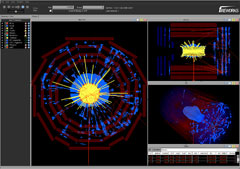 CMS sees the Beam Splash CMS sees the Beam Splash
The first CMS beam splashes was
detected on November 7th 2009.
Beam splashes are when a beam is threaded part-way through the
LHC
ring, then deliberately collided with a closed collimators, 150m
upstream of the CMS experiment. The secondary particles are
produced
by the interaction of the beam with the collimator, most of them
are
absorbed, with the exception of the muons and neutrinos. CMS can
detect muons, and what is seen is a huge splash of activity,
shown in
this event display.
The little red lines are reconstructed muon tracks, blue dots
are raw
hits, and the yellow/blue starburst in the center is the
calorimeter
energy.
It can be said that the beam is coming from the right-hand side
of the
detector ("LHC beam-1", the clockwise direction around the
ring).
more:
http://cmsdoc.cern.ch/cms/performance/FirstBeam/cms-e-commentary09.htm
Particles are back in the LHC!
News: 26 October 2009
Particles are back in the LHC!
During the last weekend
(23-25 October) particles have once again entered the LHC
after the one-year break that followed the incident of
September 2008.
Friday afternoon a first
beam of ions entered the LHC clockwise beam pipe through the
TI2 transfer line. The beam was successfully guided through
the ALICE detector until point 3 where it was dumped.
During the late evening on
Friday, the first beam of protons also entered the LHC
clockwise ring and travelled until point 3. In the afternoon
of Saturday, protons travelled from the SPS through the TI8
transfer line and the LHCb experiment, until point 7 where
they were dumped.
All settings and parameters
showed a perfect functioning of the machine, which is
preparing for its first circulating beam in the coming
weeks.

The first ion beam entering point 2 of the LHC, just
before the ALICE detector (23 October 2009)
LHC
NEWS:NATURE Article on LHC ؛LHC hopes for
collisions by Christmas
LHC NEWS: LHC
start up in 2009
The LHC will run for the first
part of the 2009-2010 run at 3.5 TeV per beam, with the energy
rising later in the run. That’s the conclusion
that we’ve just arrived at in a meeting involving
the experiments, the machine people and the CERN management.
We’ve selected 3.5 TeV because it allows the LHC
operators to gain experience of running the machine safely while
opening up a new discovery region for the experiments.
The developments that have
allowed us to get to this point are good progress in repairing
the damage in sector 3-4 and the related consolidation work, and
the conclusion of testing on the 10000 high-current electrical
connections last week. With that milestone, every one of the
connections has been tested and we now know exactly where we
stand.
The latest tests looked at the
resistance of the copper stabilizer that surrounds the
superconducting cable and carries current away in case of a
quench. Many copper splices showing anomalously high resistance
have been repaired already, and the tests on the final two
sectors revealed no more outliers. That means that no more
repairs are necessary for safe running this year and next.
The
procedure for the 2009 start-up will be to inject and capture
beams in each direction, take collision data for a few shifts at
the injection energy, and then commission the ramp to higher
energy. The first high-energy data should be collected a few
weeks after the first beam of 2009 is injected. The LHC will run
at 3.5 TeV per beam until a significant data sample has been
collected and the operations team has gained experience in
running the machine. Thereafter, with the benefit of that
experience, we’ll take the energy up towards 5 TeV per beam. At the end of 2010, we’ll run the LHC with lead-ions for the first time. After that, the LHC will
shut down and we’ll get to work on moving the
machine towards 7 TeV per beam
News on the LHC
- Information concernant le LHC
The foreseen shutdown work on
the LHC is proceeding well, including the powering tests with
the new quench protection system. However, during the past week
vacuum leaks have been found in two "cold" sectors of the LHC.
The leaks were found in sectors 8-1 and 2-3 while they were
being prepared for the electrical tests on the copper
stabilizers at around 80 K. In both cases the leak is at one end
of the sector, where the electrical feedbox, DFBA, joins Q7, the
final magnet in the sector.
Unfortunately, the repair
necessitates a partial warm-up of both sectors. This involves
the end sub-sector being warmed to room temperature, while the
adjacent sub-sector "floats” in temperature and
the remainder of the sector is kept at 80 K. As the leak is from
the helium circuit to the insulating vacuum, the repair work
will have no impact on the vacuum in the beam pipe. However the
intervention will have an impact on the schedule for the
restart. It is now foreseen that the LHC will be closed up and
ready for beam injection by mid-November.
Preparing for the LHC re-start
The end of
a Council week is a good opportunity to bring you up to
date with the status of the LHC, and I'm pleased to say
that we had a good deal of positive news to report to
the delegations today. The bottom line is that we remain
on course to restart the LHC safely this year, albeit
currently about 2-3 weeks later than we'd hoped at
Chamonix.
This
Council week has seen many important developments for
our future. I am particularly pleased that Council
approved the Medium Term Plan and budget for 2010 as
presented by the management. This is a strong vote of
confidence in all of you. The President of Council is
reporting on Council business in this issue of the
Bulletin, so I will focus on the status of the LHC.
A tremendous amount of work has been done to understand
fully the splices in the LHC's superconducting cable and
copper stabilizers. One of these splices was the root
cause of the incident last September that brought the
LHC to a standstill. We've learned a great deal since
then. It's mostly good news but there's also plenty of
food for thought. The good news is that all the
measurements done so far indicate that we will be ready
by September or October to run the LHC safely in the
range 4-5 TeV per beam. The food for thought is that the
same tests tell us that before we can run safely above 5
TeV, more work is needed. This will be carried out in
future shutdown periods.
Many
of you will have heard, or seen on the LHC web pages,
that we're warming up sector 4-5. This will give us
increased confidence that we fully understand the
splices. We're warming up this sector because we have
developed a new non-invasive technique for investigating
the splices. The sector has been measured at a
temperature of 80 K, indicating at least one suspect
splice. By warming the sector, the results of the test
can be checked at room temperature, allowing us to
confirm the reliability of the test at 80 K. If the 80 K
measurements are confirmed, any suspect splices in this
sector will be repaired. More importantly, validation of
the 80K measurements will allow the splice resistance in
the last three sectors to be measured at this
temperature, thereby avoiding the time needed for
re-warming. When these measurements are done, we'll have
to balance energy against time: 4 TeV should require no
further repairs, for example, whereas 5 TeV could call
for more work. The measurements in these last three
sectors will allow us to make that decision, determining
the initial operating energy of the LHC in the range 4-5
TeV, and the start date for the first run.
The Bulletin will continue to keep you up to date with
LHC progress, and if you are interested in a full
report, Steve Myers at CERN and Jim Strait at Fermilab
will be making detailed presentations on 2 July. Steve's
presentation will be webcast at
http://www.cern.ch/webcast.
Final LHC magnet goes underground
Geneva, 30 April 2009. The 53rd
and final replacement magnet for CERN's Large Hadron
Collider (LHC) was lowered into the accelerator's tunnel
today, marking the end of repair work above ground
following the incident in September last year that
brought LHC operations to a halt. Underground, the
magnets are being interconnected, and new systems
installed to prevent similar incidents happening again.
The LHC is scheduled to restart in the autumn, and to
run continuously until sufficient data have been
accumulated for the LHC experiments to announce their
first results.
"This is an important milestone in the repair process,"
said CERN's Director for Accelerators and Technology,
Steve Myers. "It gets us close to where we were before
the incident, and allows us to concentrate our efforts
on installing the systems that will ensure a similar
incident won't happen again."
The final magnet, a quadrupole designed to focus the
beam, was lowered this afternoon and has started its
journey to Sector 3-4, scene of the September incident.
With all the magnets now underground, work in the tunnel
will focus on connecting the magnets together and
installing new safety systems, while on the surface,
teams will shift their attention to replenishing the
LHC's supply of spare magnets.
In total 53 magnets were removed from Sector 3-4.
Sixteen that sustained minimal damage were refurbished
and put back into the tunnel. The remaining 37 were
replaced by spares and will themselves be refurbished to
provide spares for the future.
"Now we will split our team into two parts," explained
Lucio Rossi, Deputy head of CERN's Technology
Department. "The main group will carry out
interconnection work in the tunnel while a second will
rebuild our stock of spare magnets."
The LHC
repair process can be divided into three parts. Firstly,
the repair itself, which is nearing completion with the
installation of the last magnet today. Secondly, systems
are being installed to monitor the LHC closely and
ensure that similar incidents to that of last September
cannot happen again. This work will continue into the
summer. Finally, extra pressure relief valves are being
installed to
release helium in a safe and controlled manner should
there be leaks inside the LHC's cryostat at any time in
the machine's projected 15-20 year operational lifetime.
LHCNews:
LHC Luminosity Profile 2009/2010
A first estimate for the luminosity
performance for the 2009/2010 run has been posted at
http://lhc-commissioning.web.cern.ch/lhc-commissioning/luminosity/09-10-lumi-estimate.htm
LHCNews:
New Time Schedule for LHC
Message from the Director-General of CERN on the LHC
schedule
The CERN
Management today confirmed the restart schedule for the
Large Hadron Collider resulting from the recommendations
from the Chamonix workshop. The new schedule foresees
first beams in the LHC at the end of September this
year, with collisions following in late October. A
short technical stop has also been foreseen over the
Christmas period. The LHC will then run through to
autumn next year, ensuring that the experiments have
adequate data to carry out their first new physics
analyses and have results to announce in 2010. The new
schedule also permits the possible collisions of lead
ions in 2010.
This new
schedule represents a delay of 6 weeks with respect to
the previous schedule which foresaw LHC "cold at the
beginning of July". The cause of this delay is due to
several factors such as implementation of a new enhanced
protection system for the busbar and magnet splices,
installation of new pressure relief valves to reduce the
collateral damage in case of a repeat incident,
application of more stringent safety constraints, and
scheduling constraints associated with helium transfer
and storage.
In
Chamonix there was consensus among all the technical
specialists that the new schedule is tight but
realistic.
The
enhanced protection system measures the electrical
resistance in the cable joints (splices) and is much
more sensitive than the system existing on 19 September.
The new pressure relief system has been designed in two
phases. The first phase involves installation of relief
valves on existing vacuum ports in the whole ring.
Calculations have shown that in an incident similar to
that of 19 September, the collateral damage (to the
interconnects and super-insulation) would be minor with
this first phase.
The second
phase involves adding additional relief valves on all
the dipole magnets and would guarantee minor collateral
damage (to the interconnects and super-insulation) in
all worst cases over the life of the LHC. One of the
questions discussed in Chamonix was whether to warm up
the whole LHC machine in 2009 so as to complete the
installation of these new pressure relief valves or to
perform these modifications on sectors that were warmed
up for other reasons. The Management has decided for
2009 to install relief valves on the four sectors that
were already foreseen to be warmed up. The dipoles in
the remaining four sectors will be equipped in 2010.
LHC Performance Workshop, Chamonix 2009 - Message from
the Director-General
Many issues were tackled in Chamonix this
week, and important recommendations made. Under a
proposal submitted to CERN management, we will have
physics data in late 2009, and there is a strong
recommendation to run the LHC through the winter and on
to autumn 2010 until we have substantial quantities of
data for the experiments. With this change to the
schedule, our goal for the LHC's first running period is
an integrated luminosity of more than 200 pb-1 operating
at 5 TeV per beam, sufficient for the first new physics
measurements to be made. This, I believe, is the best
possible scenario for the LHC and for particle physics.
There were discussions in Chamonix between accelerator
and detector physicists on several important issues.
Agreements were reached whereby teams drawing from both
communities will work together on important subjects,
such as the detailed analysis of measurements made
during testing of magnets on the surface.
Since the incident, enormous progress has been made in
developing techniques to detect any small anomaly. These
will be used in order to get a complete picture of the
resistance in the splices of all magnets installed in
the machine. This will allow improved early warning of
any additional suspicious splices during operation. The
early warning systems will be in place and fully tested
before restarting the LHC.
Another important topic for the future was the radiation
hardness of electronics installed in the service areas
and the tunnel. For many years, particle detector
electronics have been designed to cope with events such
as loss of beam into the detectors. Until now, this has
not been necessary for the accelerators, but will become
so when the LHC moves to higher beam intensity and
luminosity. Again, with detector and accelerator
physicists working closely together, the experience
gained from the detectors can be applied to the LHC
itself.
As the Bulletin reported on 30 January, opening up a
magnet in which an anomalously high electrical
resistance was measured made the reason for the anomaly
immediately obvious - a splice had not been correctly
made. This is one of two such splices that were
identified in the five sectors tested, and as a result
the magnet containing the second will also be removed
from the tunnel for repair. Since resistance tests can
only be conducted in cold magnets, three sectors remain
to be tested: sector 3-4 where the original incident
occurred and the sectors on either side. Within sector
3-4, the 53 magnets that are being replaced in the
tunnel will all be tested before cool down, and the
sectors either side will be cooled down early enough to
intervene if necessary with no impact on the schedule.
This leaves around 100 dipole magnets that we'll not be
able to test until September and a correspondingly small
chance that we may find further bad splices that will
need to be repaired before operation starts.
The Chamonix workshop involved a lot of work by many
people. Much progress has been made, and the management
now has all it needs to make an informed decision next
Monday on LHC restart. I'd like to thank all those
involved, and I will be writing to you again early next
week to let you know our decision.
LHCNews:: LHC to restart in Summer 2009
http://press.web.cern.ch/press/PressReleases/Releases2008/PR17.08E.html
News on LHC Schedule for 2009
A
meeting, chaired by Jos Engelen, on the LHC schedule
took place on Tuesday afternoon. Participating were the
LHC Project Leader, Lyn Evans, the incoming Director of
Accelerators and Technology, Steve Myers, the LHC
coordinator, M. Ferro-Luzzi, and the Spokespersons and
Technical Coordinators of the LHC experiments.
Information was presented on the LHC schedule that
reflected present understanding. An official
presentation is being prepared for the CERN Council in
December. The schedule outlined below is therefore
still subject to changes.
Extracts from the summary of the meeting are given
below.
A lot of progress has been made in developing
diagnostic procedures (calorimetry) and tools to make
sure that no other bad splices are 'hidden' in the
machine
Moving out magnets affected by the incident has started.
It is foreseen to remove 39 dipoles, including 6 (3 at
each side) in a buffer zone. These magnets should not
be affected but will be re-tested just to confirm that
the limits of the affected region are understood.
All magnets to be brought to the surface should be out
before the Christmas shutdown. By then 20 dipoles should
already be back in the machine.
The plan is to install the first dipole (from the set of
spares) already this week.
The test bench (for cold testing) is a limiting factor.
Capacity to be ramped up after connection of 18 kW
plant (now 6 kW) in February 2009.
Last magnet should be back in end of March 2009; whole
machine cold again beginning of July. Meaning
optimistically first beam in the machine end of July.
Many activities are going on in parallel in the tunnel,
but are not (and should not come) on the critical path
(work on flanges, relief valves, cabling)
Point of concern of experiments: access conditions in
experimental caverns and service caverns. Is being
looked into by/ with Safety Commission.
Lyn Evans has been invited to give a talk on the status
of the machine on the Monday morning of the December CMS
Week.
TIME's Best Inventions of 2008

 The Large Hadron Collider
|