School of PARTICLES AND ACCELERATORS - IPM School of PARTICLES AND ACCELERATORS - IPM Institute for Studies in Theoretical Physics and Mathematics (IPM)
   
Search SCS
News
Administration
People
Groups
Courses
Conferences
Publications
Contact us
Useful links
Home Page
 
 
» HOME» NEWS


IPM Calendar


Positions in the School of Particles and Accelerators


LHC News

 
ATLAS and CMS experiments present Higgs search status (December 13, 2011)

In a seminar held at CERN today, the ATLAS and CMS experiments presented the status of their searches for the Standard Model Higgs boson.  Their results are based on the analysis of considerably more data than those presented at the summer conferences, sufficient to make significant progress in the search for the Higgs boson, but not enough to make any conclusive statement on the existence or non-existence of the elusive Higgs. The main conclusion is that the Standard Model Higgs boson, if it exists, is most likely to have a mass constrained to the range 116-130 GeV by the ATLAS experiment, and 115-127 GeV by CMS. Tantalising hints have been seen by both experiments in this mass region, but these are not yet strong enough to claim a discovery.

Full Story in English

Full Story in Persian

CMS/ATLAS combination on the SM Higgs Searches
Today at 12:30 ATLAS and CMS simultaneously made public their combined results on the Higgs Search:

 1)   
http://cms.web.cern.ch/news/atlas-and-cms-combine-summer-11-search-limits-standard-model-higgs

 2)   Corresponding video on YouTube:  
http://www.youtube.com/watch?v=jOn5YwrVcE8

 3)   Related News items and more details on new CMS web site:    
http://cern.ch/cms
OPERA experiment update (November 18, 2011)

Following the OPERA collaboration's presentation at CERN on 23 September, inviting scrutiny of their neutrino time-of-flight measurement from the broader particle physics community, the collaboration has rechecked many aspects of its analysis and taken into account valuable suggestions from a wide range of sources. One key test was to repeat the measurement with very short beam pulses from CERN.  This allowed the extraction time of the protons that ultimately lead to the neutrino beam to be measured more precisely.

Full Story

CERN has 2020 vision for LHC upgrade
(November 16, 2011)

CERN1 today kicked off the High Luminosity LHC study with a workshop bringing together scientists and engineers from some 14 European institutions, supported through the European Commission’s seventh Framework programme (FP7), along with others from Japan and the USA. The goal is to prepare the ground for an LHC luminosity upgrade scheduled for around 2020. Luminosity gives a measure of the collision rate in a particle accelerator and therefore gives an indication of its performance.Full Story

LHC proton run for 2011 reaches successful conclusion (October 31, 2011)

 
After some 180 days of running and four hundred trillion proton proton collisions, the LHC’s 2011 proton run came to an end at 5.15pm yesterday evening. For the second year running, the LHC team has largely surpassed its operational objectives, steadily increasing the rate at which the LHC has delivered data to the experiments. Full Story

 
OPERA experiment reports anomaly in flight time of neutrinos from CERN to Gran Sasso
(September 23, 2011)

The OPERA1 experiment, which observes a neutrino beam from CERN2 730 km away at Italy’s INFN Gran Sasso Laboratory, will present new results in a seminar at CERN this afternoon at 16:00 CEST. The seminar will be webcast at http://webcast.cern.ch. Journalists wishing to ask questions may do so via twitter using the hash tag #nuquestions, or via the usual CERN press office channels. Full Story

CERN's LHCb experiment takes precision physics to a new level (August 26, 2011)

Results to be presented by CERN1’s LHCb experiment at the biennial Lepton-Photon conference in Mumbai, India on Saturday 27 August are becoming the most precise yet on particles called B mesons, which provide a way to investigate matter-antimatter asymmetry. The LHCb experiment studies this phenomenon by observing the way B mesons decay into other particles. The new results reinforce earlier measurements from LHCb presented at last month’s European Physical Society conference in Grenoble, France, showing that the B meson decays so far measured by the collaboration are in full agreement with predictions from the Standard Model of particle physics, the theory physicists use to describe the behaviour of fundamental particles. Full Story

CERN’s CLOUD experiment provides unprecedented insight into cloud formation  (August 25, 2011)

In a paper published in the journal Nature today, the CLOUD1 experiment at CERN2 has reported its first results. The CLOUD experiment has been designed to study the effect of cosmic rays on the formation of atmospheric aerosols - tiny liquid or solid particles suspended in the atmosphere - under controlled laboratory conditions. Atmospheric aerosols are thought to be responsible for a large fraction of the seeds that form cloud droplets. Understanding the process of aerosol formation is therefore important for understanding the climate. Full Story

Weekly Topical Seminar: IPM@CMS Meeting

This meeting is held every Tuesday 13:30-15:30. The meeting is an on-line meeting between School of Particles and Accelerators in Larak and our group at CMS in Geneva. The connection is via the EVO (http://evo.caltech.edu/) technology and in the CMS community. The meeting is with no password and everybody is welcome to attend. Full Story


Weekly Seminar on "Top quark anomalous couplings in single top events "

Speaker: Dr. Abideh Jafari from IPM

Abstract: New interactions at higher energies may manifest themselves in the form of effective couplings of SM fermions. In this context, top quark as the heaviest fermion of the Standard Model, plays an important role since it decays before hadronization. The quark information, like spin, is therefore not lost and is accessible in decay products. It decays almost all the time to a b-quark and a W-boson and provides an interesting area to study the Wtb vertex in search for new interactions. Wtb vertex is involved also in the production of top quark (single-top), giving another place to investigate the anomalous couplings. The Large Hadron Collider is a top quark factory. Hence, precision measurements using top quark events  are possible with enough statistics.

I will present a research proposal on this subject in which all event information is used to build a likelihood to obtain the most probable values for the Wtb anomalous couplings in single-top.

Time: Wednesday, February 8, 2012 at 14:00

in Larak


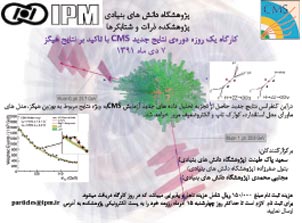
سمینار یک روزه آشنایی با شتابگر خطی

Presentations files


Two new lectures

Prof. Daniel Grumiller from Vienna University of Technology

1- IPM Colloquium on "Gravity in lower dimensions"

Abstract: He gives an introduction to gravity in two and three dimensions and address what we can learn from these theories for classical and quantum gravity.

Time: Monday, January 30, 2012 at 14:00  

in Niavaran building


2- Weekly Seminar on "The AdS/log CFT correspondence"

Abstract: I summarize the evidence accumulated so far in favor of a correspondence between certain fine-tuned gravity theories in 3 dimensions and logarithmic conformal field theories in 2 dimensions. I also address recent generalizations of this correspondence to higher spin gravity and higher-dimensional gravity theories and mention possible applications to condensed matter systems with quenched disorder.
 

Time: Thursday, February 2, 2012 at 11:00

in Larak


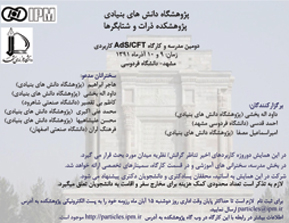
Second IPM School and Workshop on Applied AdS/CFT

May 1-8, 2012


The Second Ali-Mohammadi Prize

For the best physics PhD theses written in Iran


The Institute for Research in Fundamental Sciences (IPM) in collaboration with the Physics Society of Iran shall give a prize annually to the best PhD theses in physics written in Iran. The prize will be called "Ali-Mohammadi Prize" in recognition of the scientific and academic services rendered by the late martyred professor of the University of Tehran, Mas'ood Ali-Mohammadi, the first recipient of a PhD degree from an Iranian university, who had an influential role in creating the scientific infrastructure of IPM as well as the establishment of graduate studies in Iranian universities and academic institutions.


Full Story


IPM HOMEPAGE | IPM LIBRARY

© Copyright 2000-2012
Institute for Research in Fundamental Sciences(IPM)
All rights reserved.